
Cognitive Behavioral Therapy for OCD Treatment in Vaughan
Living with intrusive thoughts and exhausting repetitive behaviors can feel like being trapped in an endless loop. For individuals seeking Cognitive Behavioral Therapy for OCD Treatment in Vaughan, evidence-based psychological services offer a proven path toward lasting relief and control over your mental well-being.
What Is Obsessive-Compulsive Disorder and How Does It Affect Mental Health?
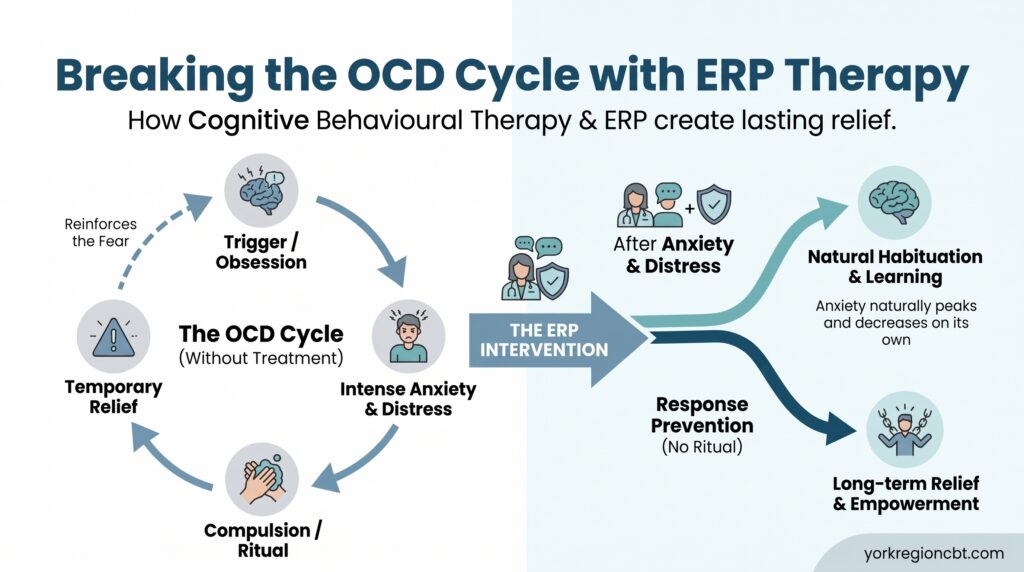
Obsessive-Compulsive Disorder (OCD) is a neurobiological mental health condition characterized by a distressing cycle that significantly impacts daily living:
-
Obsessions: Recurrent, unwanted, and intrusive thoughts, images, or urges that trigger severe anxiety or discomfort.
-
Compulsions: Repetitive behaviors or mental acts performed to reduce distress or neutralize a perceived threat.
-
The OCD Loop: Compulsions provide temporary short-term relief, but ultimately reinforce the brain’s alarm system and strengthen the cycle over time.
-
Functional Impact: OCD goes far beyond a simple preference for order; it can consume hours each day, severely disrupting personal relationships, work performance, and overall quality of life.
What Are the Common Symptoms and OCD Subtypes?
While OCD manifests differently for every individual, symptoms generally group into core subtypes:
-
Contamination OCD: Intense fear of germs, illness, or chemical exposure leading to excessive washing or cleaning.
-
Harm OCD: Persistent fears of accidentally or intentionally harming oneself or loved ones, accompanied by checking or mental review.
-
Pure O (Predominantly Obsessional): Intrusive thoughts regarding taboo themes (religious, sexual, or existential) where compulsions are primarily internal mental rituals.
-
Symmetry & Just Right OCD: An overwhelming compulsion to arrange, align, or repeat actions until they feel “just right.”
Why Standard Talk Therapy Often Fails for OCD Patients
Traditional supportive talk therapy often encourages clients to explore the origin of their intrusive thoughts or rationalize their fears. In OCD treatment, this approach frequently backfires:
Clinical Insight: Analyzing or rationalizing obsessive thoughts treats them as meaningful signals rather than brain “false alarms.” This inadvertent validation often acts as a cognitive compulsion, reinforcing the obsession and deepening the OCD cycle.
Effective care requires specialized behavioral interventions specifically designed to target the neurocognitive mechanisms maintaining OCD.
How Does Cognitive Behavioural Therapy (CBT) Work to Treat OCD?
Cognitive Behavioural Therapy (CBT) focuses on identifying and shifting distorted thought patterns and maladaptive behaviors. When applied to OCD, CBT helps clients recognize that intrusive thoughts are neutral, automatic brain events rather than direct threats or moral failings.
For a comprehensive overview of how treatment unfolds in practice, explore our cognitive behavioural therapy process explained resource.
What Role Does Exposure and Response Prevention (ERP) Play Within CBT for OCD?
Exposure and Response Prevention (ERP) is the gold-standard behavioral component of CBT for OCD.
-
Exposure: Systematically confronting triggers, images, and situations that provoke obsessive anxiety.
-
Response Prevention: Voluntarily choosing to refrain from engaging in compulsive rituals or avoidance behaviors.
Through repeated ERP exercises, the brain undergoes inhibitory learning, discovering that anxiety naturally peaks and subsides on its own without needing compulsions.
What Are the Steps Involved in a Typical CBT With ERP Treatment Cycle?
-
Comprehensive Assessment & Psychoeducation: Evaluating symptom history, identifying unique triggers, and learning the cognitive-behavioral model of OCD.
-
Constructing the Exposure Hierarchy: Collaboratively building a stepped list of triggering situations rated by subjective units of distress (SUDs).
-
Gradual Systematic ERP: Working through exposures from lower-level triggers to challenging scenarios while strictly blocking compulsive responses.
-
Relapse Prevention & Maintenance: Consolidating coping strategies, building long-term autonomy, and establishing self-exposure routines.
How Do Clinicians Measure OCD Severity Using the Yale-Brown Obsessive Compulsive Scale (Y-BOCS)?
The Yale-Brown Obsessive Compulsive Scale (Y-BOCS) is the international clinical benchmark for measuring OCD severity. It evaluates the degree of distress, time occupied, functional interference, resistance effort, and control regarding both obsessions and compulsions.
What Are Y-BOCS Score Thresholds and Their Clinical Meaning?
| Y-BOCS Score Range | Severity Level | Clinical Meaning |
| 0 – 7 | Subclinical | Minimal or no clinically significant OCD symptoms. |
| 8 – 15 | Mild | Noticeable symptoms causing mild distress; responsive to targeted CBT. |
| 16 – 23 | Moderate | Clear interference in daily social and occupational functioning. |
| 24 – 31 | Severe | Major functional disruption and severe daily distress. |
| 32 – 40 | Extreme | Near-constant obsessions/compulsions causing severe incapacitation. |
How Are Y-BOCS Scores Used to Tailor CBT and ERP Protocols?
Y-BOCS scores establish a clear, objective baseline for clinical decision-making:
-
Tracking Progress: A 35% or greater reduction in Y-BOCS total scores represents a clinically significant treatment response.
-
Protocol Adjustments: Higher baseline scores (24+) guide clinicians to design gentler ERP exposure steps or suggest combined pharmacological care to lower baseline distress prior to intense exposure work.
What Are the Different OCD Subtypes and How Are CBT Protocols Tailored for Each?
Standardized treatments must be adapted to fit specific symptom themes and manifestations.
How Is CBT Customized for Pure O, Contamination, and Harm OCD?
-
Pure O: ERP focuses heavily on imaginal exposures (writing or listening to scripts of feared scenarios) and response prevention targeting hidden mental rituals like checking feelings or reassurance-seeking.
-
Contamination OCD: In-vivo exposures involve deliberately touching “contaminated” items without engaging in washing routines or using sanitizers.
-
Harm OCD: Exposure exercises involve holding safe household tools (like kitchen knives) near loved ones while refraining from mental review or seeking safety assurances.
What Behavioral and Cognitive Strategies Address Symmetry and Other OCD Variants?
For symmetry and ordering OCD, behavioral trials involve intentionally leaving objects misaligned or out of order to build tolerance for incomplete or “not right” feelings.
What Are the Benefits and Limitations of CBT Compared to Medication for OCD?
CBT with ERP Benefits
-
Teaches lifelong distress-tolerance and coping tools.
-
Significantly lower relapse rates after treatment completion compared to medication alone.
-
Free from pharmaceutical side effects.
Medication (SSRIs) Benefits & Limitations
-
Selective Serotonin Reuptake Inhibitors (SSRIs) can reduce baseline symptom intensity.
-
Symptoms frequently return once medication is discontinued if behavioral strategies were not learned.
How Effective Is CBT With ERP Versus SSRIs and Other Pharmacological Treatments?
Research Standard: Clinical studies consistently demonstrate that CBT incorporating ERP achieves superior long-term outcomes compared to medication monotherapy. A combined treatment plan (CBT + SSRIs) is often recommended for severe Y-BOCS scores to facilitate initial ERP engagement.
Can CBT Completely Cure OCD or Is It a Symptom Management Approach?
OCD is generally understood as a manageable chronic condition rather than something that receives an absolute “cure.” However, through structured Cognitive Behavioral Therapy for OCD Treatment in Vaughan, individuals frequently achieve clinical remission—learning to interact with intrusive thoughts without anxiety or disruption.
How Can You Find and Choose a Specialized CBT Therapist for OCD Treatment?
Finding the right clinician is critical to achieving positive therapeutic outcomes.
What Qualifications Should You Look for in a CBT or ERP Therapist?
-
Specialized Training: Look for registered mental health professionals (Psychologists, Psychotherapists) with dedicated, post-graduate training in ERP and CBT for OCD.
-
Clinical Expertise: Verify that the clinician regularly treats OCD rather than offering generalized counseling.
-
Evidence-Based Focus: Ensure the practitioner utilizes structured assessment tools like the Y-BOCS to track ongoing treatment response.
How Does Telehealth Facilitate Access to Evidence-Based OCD Treatments?
Virtual therapy allows clients across Vaughan, Newmarket, and the broader York Region to complete ERP exercises directly in their home environment—where real-world triggers and rituals naturally occur.
Ready to Reclaim Control Over Your Mental Health?
You don’t have to navigate intrusive thoughts and compulsions alone. If you are looking for specialized Cognitive Behavioral Therapy for OCD Treatment in Vaughan, our team of experienced CBT and ERP therapists at York Region CBT is here to help you break the cycle of OCD.
Contact York Region CBT today to schedule a confidential consultation and take the first step toward lasting recovery and peace of mind.