
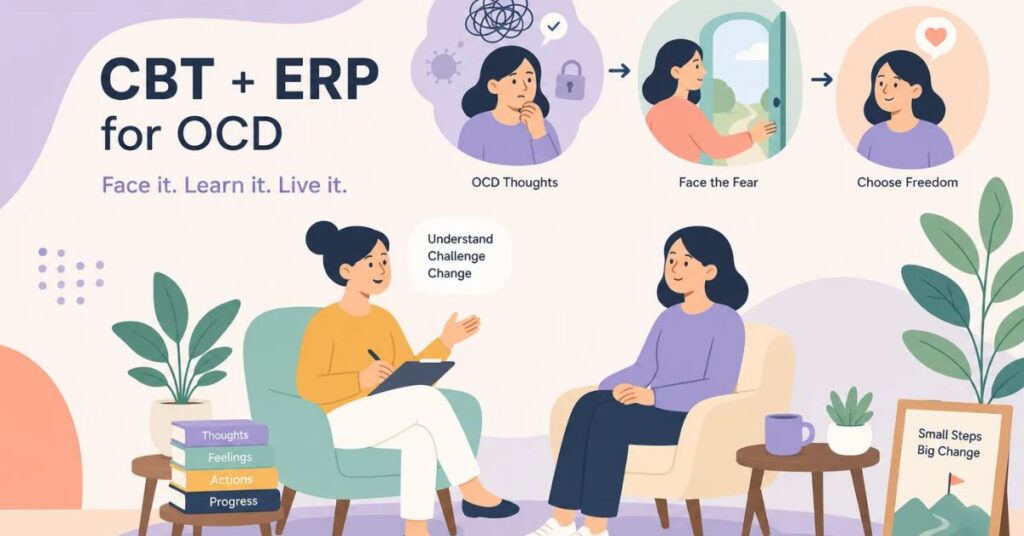
How CBT and Exposure and Response Prevention Work for OCD: What to Expect in Therapy
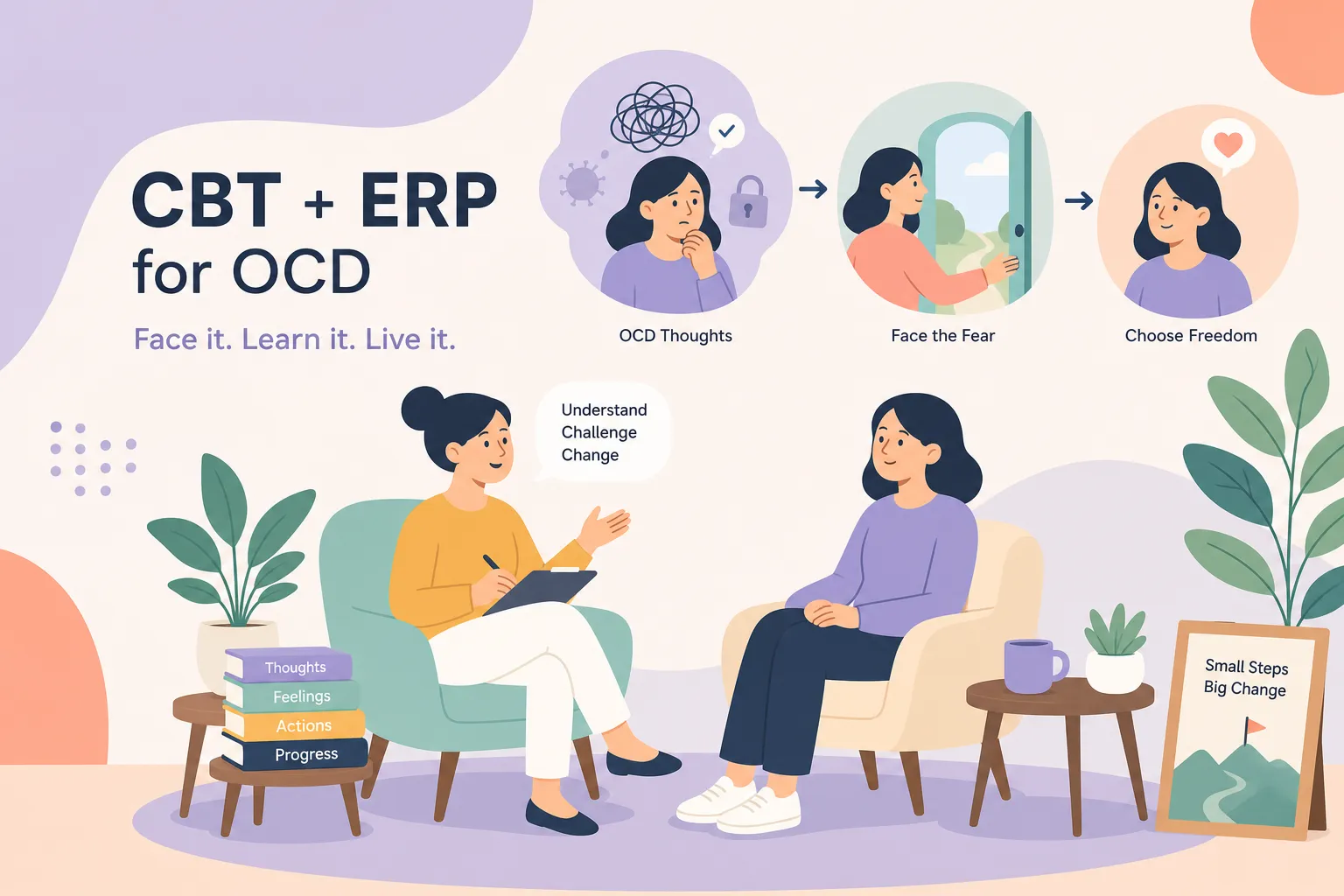
What OCD Actually Is (And Why It’s So Often Misunderstood)
-
Obsessions: Unwanted, intrusive thoughts, images, or urges that cause significant distress and feel impossible to ignore. They aren’t ordinary worries; they arrive unbidden and feel “sticky”.
-
Compulsions: Mental or physical rituals performed to relieve that distress, at least temporarily.
The Cycle of Obsessive-Compulsive Disorder:
-
Intrusive Obsession: An unwanted, distressing thought, image, or urge triggers sudden anxiety.
-
Severe Anxiety & Distress: The brain flags the obsession as an immediate threat.
-
Compulsive Ritual: Physical or mental compulsions are performed to reduce the discomfort.
-
Temporary Relief: Distress drops briefly, teaching the brain that the ritual was necessary.
-
Cycle Reinforcement: The anxiety loop resets, making the next intrusive thought feel even more urgent.
Clinical Insight: Compulsions do not have to be physical or visible. Mental rituals—such as reviewing memories, repeatedly seeking reassurance, or neutralizing “bad” thoughts with “good” ones—are full compulsions that keep OCD active.
-
Contamination OCD
-
Harm OCD
-
Religious & Scrupulosity OCD
-
Relationship OCD (ROCD)
-
Sexual Orientation OCD
Why CBT with Exposure and Response Prevention (ERP) is the Gold-Standard Treatment
How ERP Rewires the Threat Response:
-
Identify Trigger / Obsession: Face the specific feared situation or thought directly.
-
Controlled Exposure: Enter the triggering environment systematically.
-
Prevent the Compulsion: Refrain from performing any physical or mental rituals.
-
Inhibitory Learning & Habituation: Allow distress to decrease naturally, teaching the brain that the feared outcome does not require a ritual response.
Treatment Effectiveness by the Numbers
-
Adult Response Rates: In standard clinical settings, 65–80% of clients who complete ERP show significant symptom reduction. Intensive protocols report response rates approaching 90%.
-
Adolescent Outcomes: Long-term 12-month follow-up studies for children and teenagers demonstrate response rates as high as 92%.
Warning: Generic counselling—including standard CBT focused on thought challenging, positive reframing, or reassurance—can actually exacerbate OCD. Analyzing why a thought is scary or seeking rationalization acts as a mental ritual, feeding the obsession.
What to Expect in OCD Therapy Sessions
Phase 1: Assessment and Mapping (Sessions 1–3)
-
Gathering historical background and identifying specific obsessions and compulsions.
-
Evaluating functional impact across home, work, and social environments.
-
Screening for co-occurring conditions like depression or panic disorder.
-
Co-creating an exposure hierarchy—a structured ranking of feared situations rated from least to most distressing.
Case Example: A client arrived at our clinic believing she was experiencing generalized anxiety. Through a detailed OCD assessment, we identified that her nightly habit of researching symptoms online was a compulsive reassurance cycle. Transitioning her treatment to structured CBT for OCD resolved her symptoms rapidly.
Phase 2: Session Structure & Homework Execution
-
Reviewing between-session exposure practice and troubleshooting obstacles.
-
Conducting an in-session exposure task guided by the therapist.
-
Designing specific daily home practice tasks for the upcoming week.
| OCD Severity Level | Typical Course Duration | Expected Session Count |
| Mild OCD | 2 – 3 Months | 8 – 12 Sessions |
| Moderate to Severe OCD | 3 – 5 Months | 12 – 20 Sessions |
| Complex / Comorbid Presentations | 5+ Months | 20+ Sessions (plus boosters) |
Specialized OCD Therapy for Adolescents
-
Parental Involvement: Training parents to eliminate accommodating behaviors (such as answering reassurance questions) without escalating conflict.
-
Context-Specific Exposures: Tailoring exposure exercises to peer dynamics, academic stress, and school environments.
Frequently Asked Questions: Medication, Virtual Therapy, and Relapse Prevention
Does OCD Therapy Require Medication?
-
First-Line SSRIs: Medications such as fluoxetine, fluvoxamine, and sertraline are standard pharmacological treatments in Canada.
-
Higher Dosing: OCD treatment typically requires higher SSRI dosages than standard anxiety protocols, requiring up to 12 weeks at therapeutic levels for full evaluation.
-
Combined Approach: Combining medication with ERP yields superior outcomes compared to monotherapy alone.
Is Virtual ERP Therapy as Effective as In-Person Treatment?
Comparing Session Environments:
-
In-Person Therapy Sessions: Trigger exposures rely on clinic office simulations or hypothetical scenarios.
-
Virtual Therapy Sessions: Direct, real-time exposure to your actual living space—including kitchen, bathroom, and bedroom triggers right where compulsions naturally occur.
How Does Relapse Prevention Work?
Finding Qualified OCD Therapy in Vaughan and the GTA
-
“Do you specifically utilize Exposure and Response Prevention (ERP) for OCD treatment?”
-
“What percentage of your active caseload is dedicated to OCD?”
-
“Are you experienced in working with taboo OCD subtypes like harm or scrupulosity?”
Recommended Provider Directories
-
IOCDF Directory: Filters providers by region and BTTI (Behavior Therapy Training Institute) certification.
-
CACBT Directory: Lists Canadian clinicians certified in cognitive-behavioural therapies.
-
College of Psychologists of Ontario: Verifies professional registration and clinical practice standing.