
Cognitive Behavioural Therapy Techniques for Mental Health
When exploring Cognitive Behavioral Therapy techniques, it helps to understand that CBT relies on three foundational interventions: cognitive restructuring, exposure exercises, and behavioral activation. Each targets the interconnected link between thoughts, feelings, and actions.
At York Region CBT, our team applies these evidence-based tools alongside Emotion-Focused Therapy (EFT) and Mindfulness-Based Interventions for anxiety, depression, OCD, and stress. Delivered by licensed clinical psychologists, our care is available through individual, virtual, or group therapy formats.
Key Takeaways
CBT operates on the principle that thought patterns directly influence emotions and subsequent behaviors.
Two families of CBT interventions exist: cognitive techniques restructure unhelpful thinking, while behavioral techniques modify action patterns.
York Region CBT provides professional CBT services in Vaughan, Ontario, for residents seeking evidence-based psychological care.
Self-directed CBT practice allows individuals to apply therapeutic techniques independently between formal therapy appointments.
Why Do Your Thoughts Shape How You Feel and Act?
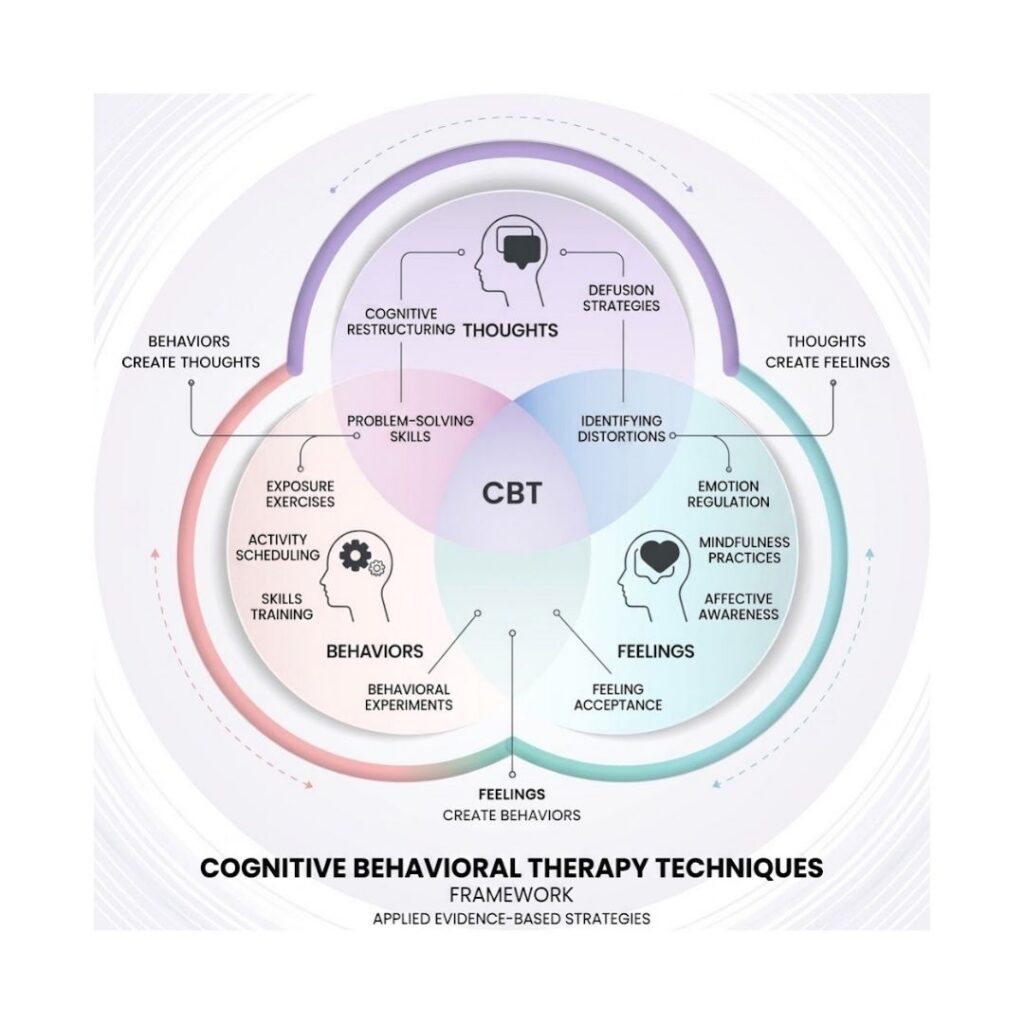
Thoughts, feelings, and behaviors operate as a connected system rather than separate experiences. A single thought about failure can trigger a feeling of dread, and that dread often leads to avoidance—skipping a meeting, canceling plans, or staying in bed. Cognitive Behavioral Therapy techniques target this chain directly, working from the premise that thought patterns shape emotions, which then drive behavior.
This chain reaction explains why anxiety and low mood feel so persistent. Left unexamined, a distorted thought (“I always mess things up”) repeats itself, reinforcing the emotional response and locking in avoidant behavior. Breaking the cycle at any point—thought, feeling, or action—changes the downstream outcome.
How does changing a thought change a feeling?
Reframing a thought interrupts the automatic slide into distress. Someone convinced a presentation will “definitely go wrong” carries that certainty into the room as intense anxiety. Questioning the accuracy of that prediction loosens its emotional grip before anxiety takes total control.
Can behavior influence thoughts too?
Yes—the relationship runs in both directions. Taking a small, manageable action (such as attending an event despite the urge to cancel) often produces real-world evidence that contradicts the original negative thought, weakening it over time.
This three-way link forms the structural core of CBT:
-
Thoughts: Automatic interpretations and predictions generated by the mind.
-
Feelings: The emotional response produced by those interpretations.
-
Actions: The behaviors that follow, which often reinforce the original thought.
York Region CBT applies this framework across our in-person and virtual psychotherapy services, delivered from our Vaughan, Ontario practice. Clinicians work with each client to identify where the thought-feeling-behavior cycle breaks down to build more accurate, workable patterns in its place.
What Core Techniques Make Up Cognitive Behavioral Therapy?
Two families of tools structure every Cognitive Behavioral Therapy technique: cognitive methods and behavioral methods. Cognitive techniques target unhelpful thinking patterns directly, while behavioral techniques reshape the actions that keep those thought patterns alive.
Left unaddressed, distorted thinking and avoidance behaviors reinforce each other, deepening anxiety, stress, and low mood. For a deeper breakdown of how this approach compares to traditional talk therapy, read our comprehensive guide on what Cognitive Behavioral Therapy is.
What do cognitive techniques involve?
Cognitive methods work by identifying and restructuring distorted thoughts. This category includes:
-
Cognitive Restructuring: Challenging cognitive distortions and testing catastrophic predictions against objective evidence.
-
Defusion Strategies: Creating psychological distance from unhelpful thoughts rather than fighting or accepting them as absolute truth.
-
Structured Problem-Solving: Building practical, action-oriented responses to real-life stressors.
What do behavioral techniques involve?
Behavioral methods change patterns of action rather than thought:
-
Exposure Exercises: Reducing avoidance through gradual, controlled contact with feared situations (frequently used in Exposure and Response Prevention for OCD).
-
Activity Scheduling: Restoring engagement in valued, rewarding activities during periods of low mood or depression.
-
Skills Training: Developing practical coping strategies for high-stress environments.
Clinical Insight: No single technique fits every concern. Matching the right technique family to your specific symptom presentation remains central to effective, individualized care.
Our psychotherapy program extends these techniques to children, adolescents, and adults, addressing a wide range of difficulties within one unified clinical framework.
How Can CBT Techniques Ease Anxiety and Stress?
Clinical research from authoritative bodies like the American Psychological Association (APA) identifies Cognitive Behavioral Therapy as a first-line, empirically supported treatment for anxiety disorders. CBT interrupts anxiety at its source rather than simply managing symptoms after they appear.
Why Do CBT Techniques Work on Anxious Thoughts?
CBT treats anxiety as a maintained pattern rather than a fixed personality trait. Structured protocols identify the specific thoughts and behaviors sustaining fear over time, then apply targeted tools to shift them. This precision separates CBT from open-ended talk therapy.
Anxiety protocols typically combine several targeted elements:
-
Identifying maladaptive thought patterns that fuel chronic worry and catastrophic thinking.
-
Addressing avoidance behaviors that reinforce fear over time.
-
Applying specialized protocols tailored to specific anxiety presentations (such as social anxiety, panic disorder, or generalized stress).
Because CBT protocols vary by presentation, treatment is never one-size-fits-all. York Region CBT’s Adult Therapy Program reflects this principle directly, offering comprehensive psychological assessments and treatments designed around each client’s unique profile.
Can You Practice CBT Skills Between Sessions?
Practicing Cognitive Behavioral Therapy techniques outside the therapy room is essential to how treatment works. Structured practice between appointments carries as much weight as the session itself, as new neural pathways and behavioral habits require repetition to stick.
Sessions frequently conclude with a specific action plan rather than a vague suggestion to “feel better.”
Therapy Session ──► Homework Assignment ──► Real-World Practice ──► Long-term Mastery
What Kind of Homework Does CBT Typically Involve?
-
Behavioral Experiments: Testing out a specific prediction (e.g., riding an elevator to challenge a fear of enclosed spaces).
-
Activity Scheduling: Committing to a set number of planned, engaging activities within a defined timeframe.
-
Thought Records: Writing down automatic predictions and cognitive distortions as they occur throughout the day.
Where Can Clients Start Practicing These Skills?
For individuals looking to explore self-help techniques before or alongside formal treatment, York Region CBT offers interactive resources to build foundational coping strategies. Whether attending in-person at our clinic or utilizing virtual care, consistent home practice ensures new habits endure.
What Should You Expect From Starting CBT Therapy?
New clients at York Region CBT gain access to care quickly. Our practice maintains immediate appointment availability for children, adolescents, and adults, avoiding the multi-month waitlists common elsewhere.
Who Can Access Treatment at York Region CBT?
Families with children, teenagers, and adults qualify for services under our specialized clinical programs. Immediate scheduling applies across all age categories.
How Much Does CBT Therapy Cost?
Fees for psychological services align with guidelines established by the Ontario Psychological Association (OPA). York Region CBT adheres to these standards to provide transparent, professionally regulated rates.
Insurance Note: Extended health benefit plans frequently cover services provided by registered psychologists and psychological associates. We encourage clients to check their specific policy limits.
Prospective clients starting therapy can expect:
-
Prompt scheduling for children, adolescents, and adults.
-
Evidence-based treatment grounded in validated cognitive and behavioral methods.
-
Fee structures aligned with Ontario Psychological Association standards.
-
Customized care plans tailored to your specific emotional and behavioral goals.
Frequently Asked Questions
What are the main types of CBT techniques?
CBT techniques fall into two primary families: cognitive techniques (which restructure unhelpful thinking patterns) and behavioral techniques (which modify action patterns and avoidance behaviors that reinforce distress).
How does changing behavior affect negative thoughts?
Taking a small, manageable action—such as attending a social event despite an urge to isolate—provides concrete real-world evidence that contradicts original catastrophic predictions, weakening those negative thoughts over time.
Where does York Region CBT provide these techniques?
York Region CBT delivers cognitive restructuring, exposure exercises, and behavioral activation from our Vaughan, Ontario clinic through licensed clinical psychologists. Services are offered via individual, virtual, or group therapy formats.
Conclusion
Cognitive Behavioral Therapy techniques represent a cornerstone of modern, evidence-based mental health care. By engaging with CBT, Exposure and Response Prevention (ERP), Emotion-Focused Therapy (EFT), and mindfulness practices, clients develop sustainable https://www.google.com/search?q=https://yorkregioncbt.com/contact/strategies for managing anxiety, depression, OCD, and stress.
York Region CBT delivers these proven approaches through personalized treatment plans, empowering you to achieve lasting improvements in your psychological well-being. Contact York Region CBT today to schedule an initial intake assessment with a licensed clinician.